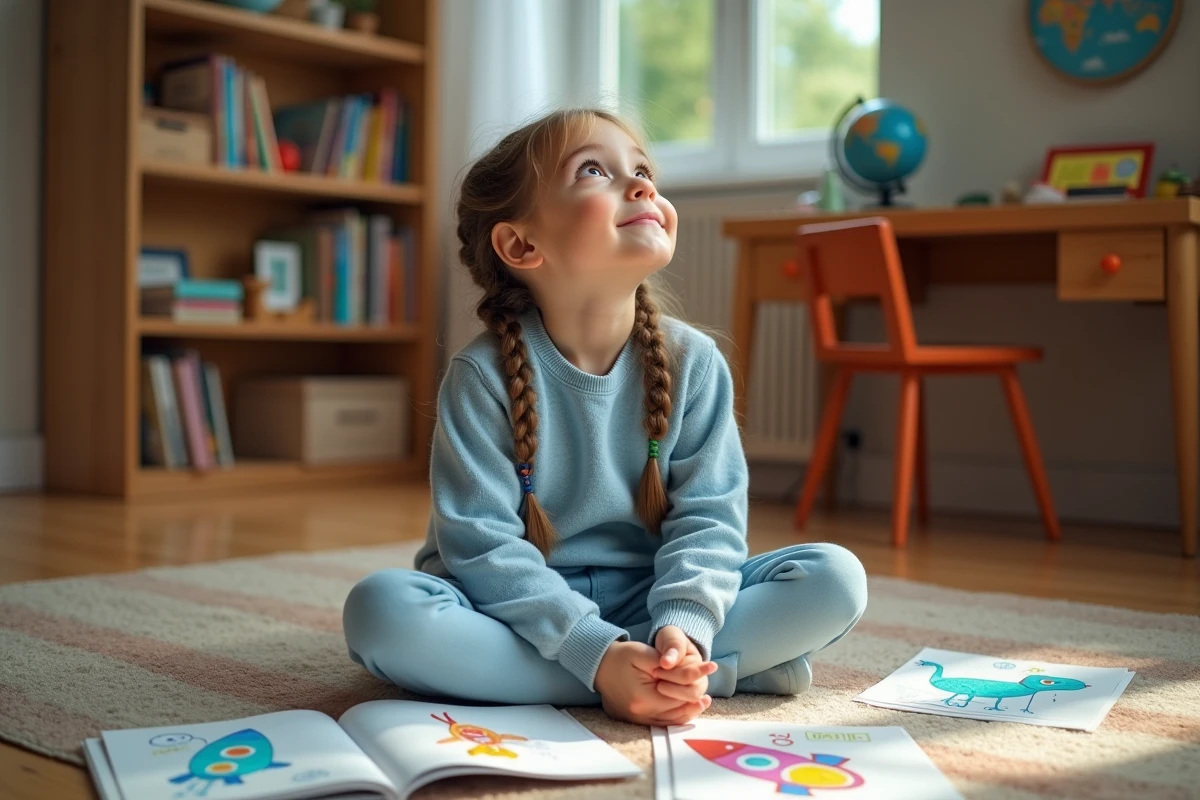
A six-year-old child who declares wanting to become a “submarine hut inventor” is not throwing a tantrum. They are practicing projecting their thoughts into the future, a cognitive skill that researchers call prospective thinking. According to a meta-analysis by Thomas Suddendorf’s team published in 2023, children trained to imagine different future scenarios manage anxiety related to uncertainty better.
Helping a child to dream about their future provides them with a concrete tool for resilience, not just feeding a fantasy.
Prospective thinking in children: why future dreams protect
When asked “what do you want to do later?”, a specific mechanism is activated: the ability to narrate themselves in the future. This ability, documented in developmental psychology, shows a correlation with well-being in adolescence, particularly resilience in the face of difficult events.
Specifically, a child who imagines themselves as a veterinarian does not just focus on the job itself. They construct a narrative where they see themselves acting, making decisions, solving problems. It is this internal narrative that matters, not the job description.
This mechanism can be reinforced in daily life. In the evening, instead of asking “what did you do today?”, we reverse the question: “tomorrow, what would you like to try?”. This temporal shift encourages the child to formulate an intention and then visualize it.
The project Quand Je Serai Grande fits into this logic by offering children stories and videos centered on varied life paths, which broaden their horizons.
Eco-anxiety and uncertainty: adapting the way we talk about jobs
Since the pandemic, several French surveys (UNICEF France 2021, Observatoire de la vie étudiante 2023) report a significant increase in concern for the future among children and pre-teens. Many declare that their future dreams are “fragile” or “threatened” by climate change and global instability. This realization changes the game for parents and teachers.
Faced with a child who says “what’s the point of dreaming if the planet is in trouble”, we cannot respond with a catalog of jobs. Ecological awareness is present, and it alters the way children dare to articulate their dreams.
What works on the ground is linking the dream to a tangible action. A child passionate about marine animals does not need to be told “become a marine biologist”. Instead, we suggest documenting the species in the nearest pond, filming their observations, keeping a notebook. The dream remains intact, but it is grounded in reality.
Three concrete levers to transform anxiety into projects
- Associate each dream with an observable action this week, not in ten years. A child who wants to “save the forests” can start by identifying three trees in their neighborhood and understanding their life cycle.
- Show non-linear paths through stories and videos. Children exposed to varied trajectories (career changes, hybrid jobs) formulate more flexible and less anxiety-inducing dreams.
- Welcome ambiguity without correcting it. If a child hesitates between five desires, it is a sign of imaginative richness, not indecision. Feedback varies on this point, but forcing a choice too early freezes rather than reassures.
Imagination and profession: moving beyond the ONISEP checklist reflex
The classic reflex is to steer the conversation towards a list of existing jobs. The child says “I want to create video games”, and the parent immediately jumps to engineering schools. This approach skips a step: understanding what the child envisions for themselves in that dream.
Behind “creating video games” sometimes lies the desire to tell stories, to draw worlds, to solve logical puzzles, or simply to work with friends. Each of these motivations opens very different paths.
A simple method: ask the question “what do you like about that?” and listen to the answer without rephrasing it. A child who responds “I like inventing characters” is not talking about the same dream as one who says “I like it to be difficult to solve”.
The impact of gendered representations on children’s imagination
Since 2022, the Council of Europe has recommended integrating education on digital citizenship and climate from primary school. This recommendation also aims to broaden professional representations beyond gender stereotypes. A girl who dreams of space mechanics and a boy attracted to animal care deserve the same support without surprise or implicit correction.
Videos, stories, and narratives play a direct role in this regard. A child who regularly sees female engineers or male educators in their daily content integrates these possibilities as normal, not as exceptions to celebrate.
Children’s dreams and daily life: where to draw the line between encouraging and guiding
We often hesitate between two stances. Validating all dreams without filter (“yes, you will be an astronaut-chef-tamer”) or reframing too quickly (“be realistic”). Neither works in the long term.
Encouraging a dream means asking questions about it, not just confirming it repeatedly. “How do you imagine your day if you do this job?”, “What would you do first when you arrive at work?”: these questions push the child to deepen their imagination. They also gradually teach them that dreaming requires construction.
The other common pitfall is projecting one’s own regrets. A parent who could not pursue artistic studies may over-invest in their child’s artistic dream or, conversely, discourage it out of protection. In both cases, the dream belongs to the child, not the parent.
The last useful gesture remains the most discreet: leaving books, documentaries, and blank notebooks lying around. A child who stumbles upon an atlas of marine life on a Sunday afternoon does not need anyone to start dreaming. The environment does the work, as long as it is nourished without commentary.