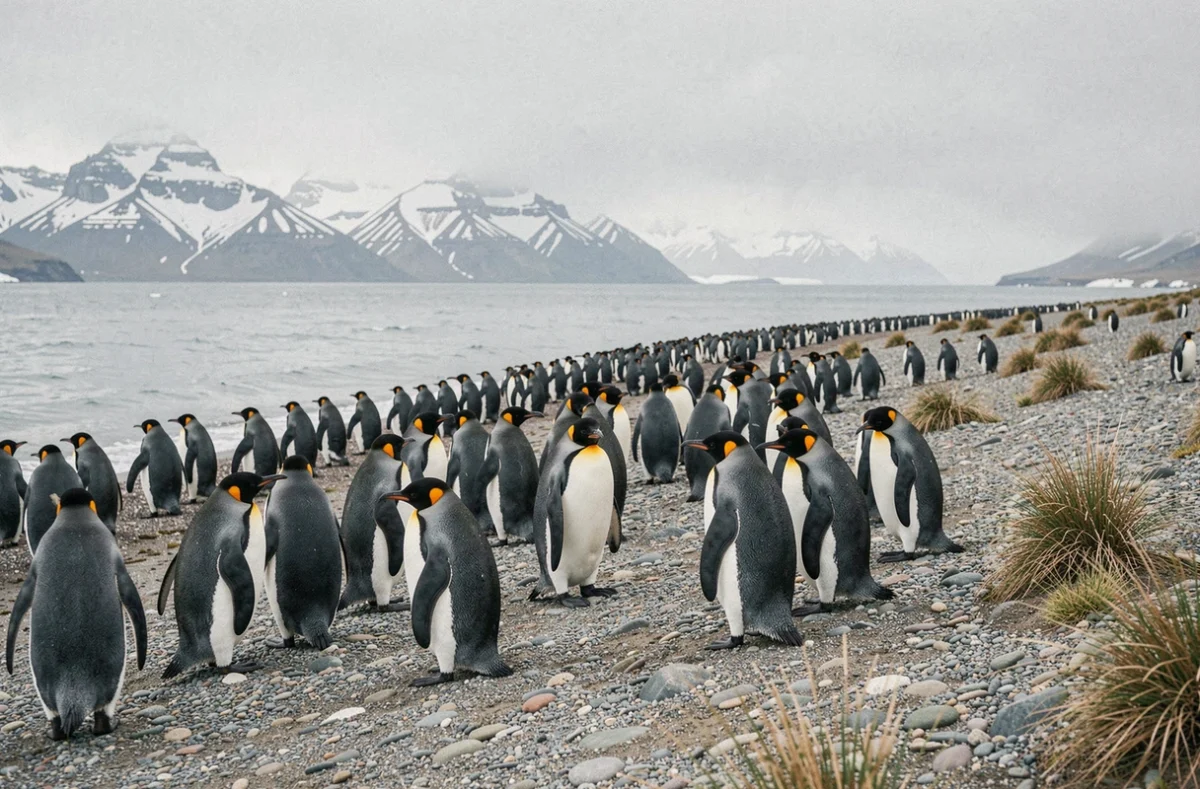
The Pix exercise “Penguin Beach” confronts each candidate with a concrete problem of visual verification: a beach photo has been edited to insert penguins, and one must trace back to the unaltered shot. The difficulty lies not in the montage itself, which is rather rudimentary, but in the search method used to isolate the original background among millions of indexed images.
Crop Before Searching: Google Lens Logic Against Composite Montages
Most guides on the subject recommend dragging the modified image into Google Images. This approach works, but it submits the entire visual to the engine, including the penguins. The engine then tries to find global matches, which drowns the results in photos of penguin colonies unrelated to the desired beach.
Since the evolution of Google Images into Google Lens, a more precise option exists: crop only the visible beach area around the penguins. By selecting the background (sand, sea, vegetation, sky) and excluding the montage area, one directs Lens towards the graphical structure of the original setting. The engine then compares this portion with its index and offers much more relevant partial matches.
To refine further, Lens allows adding keywords after cropping. Typing “tropical beach” or “pineapple beach” (if one already has a hint) significantly reduces noise in the results. Finding the original beach image with the penguins thus relies less on luck and more on a methodical framing of the area submitted to the engine.

Reverse Image Search: Why One Engine is Not Enough
Google Lens and traditional reverse search do not serve exactly the same role. Lens identifies objects, text, and places; source search targets occurrences of the same photograph on the web. When the option “find the source of the image” appears in the results, it points to the pages that published the shot, which helps trace back to the unedited version.
Bing Visual Search serves as a useful second check. Its index is not identical to Google’s: it can find pages containing the image, similar visuals, or associated products. Comparing results from both engines avoids reliance on a single index and increases the chances of finding the original photo published in a different context.
TinEye operates on a different principle. This specialized engine compares the digital fingerprint of the submitted image with its own database. It is particularly suited for spotting earlier versions of a photo, as it allows sorting results by the date of first appearance online. For the Pix exercise, this chronological sorting can reveal the initial publication of the beach before any montage.
Limitations to Keep in Mind
Results from a reverse search do not automatically prove the origin of an image. Engines classify visual matches and associated pages, not certainties. One must check the caption, publication date, and context of the source page before concluding that a result is indeed the original photo.
A widely shared image may appear on dozens of sites without any being the primary source. The available data does not always allow for a clear decision, especially when metadata has been removed during successive shares.
Visual Observation and Metadata: What the File Can Reveal
Even before launching a reverse search, a careful examination of the montage provides clues. In the “Penguin Beach” photo, the inserted areas often show visual hints:
- Slightly cut-out edges around the penguins, with a border color different from the background
- Inconsistent lighting between the penguins and the setting (shadows in opposite directions, mismatched brightness)
- A resolution or photographic grain that differs between the inserted subject and the background
These details confirm that it is a montage and help to precisely delineate the area to crop for reverse searching.
On the file side, EXIF metadata may contain the name of the editing software used, the modification date, and sometimes the GPS coordinates of the original shooting location. In practice, this metadata is often erased by social networks and sharing platforms. If preserved, a tool like ExifTool or the properties inspector of the operating system displays it in just a few clicks.

Privacy and Choice of Image Search Service
Submitting an image to a reverse search engine means transferring it to the servers of the service used. Data retention practices vary from tool to tool. Google and Bing integrate these searches into their advertising ecosystem. TinEye claims not to store images submitted by users beyond processing the request.
For a school exercise like Pix, the stakes remain limited. However, in a professional or journalistic context (verifying a conflict photo, a document leak), the choice of service deserves careful consideration. Some open-source tools allow for local visual comparisons without sending to a third-party server.
Answering the Pix Question: What Do the Penguins Hide on the Beach
By applying the cropping method in Google Lens or conducting a reverse search across multiple engines, one can find the unmodified beach photo. The penguins hide a pineapple visible on the sand in the original version of the shot.
The answer itself matters less than the skill being assessed. Pix tests the ability to trace back to the source of a modified visual content, a skill that far exceeds the scope of a multiple-choice quiz. Knowing how to isolate a useful area in a montage, cross-reference results from several engines, and verify the publication context constitutes a foundation of digital literacy applicable to detecting visual misinformation in daily life.