
On a a Sunday morning, we take out the lawnmower to enjoy a spell of nice weather. The neighbor, on the other hand, is enjoying a lie-in. This discrepancy generates neighborhood tensions every year that can lead to fines. The problem is that mowing hours vary from one municipality to another, and the famous time slot of 10 AM – 12 PM on Sundays is not a national rule set in stone.
Gas or electric mower: does your municipal order make a difference?
It is often overlooked, but some municipal or prefectural orders explicitly distinguish between gas-powered machines and electric models. A gas mower produces a significantly higher noise level than a battery-operated model, and some municipalities respond by tightening the allowed time slots for the loudest devices.
To find out if your municipality applies this distinction, you can search the text of the order for the terms “gardening equipment,” “gas engines,” or “mowers.” These documents can be consulted at the town hall, sometimes online on the municipality’s or prefecture’s website.
If the order does not mention any distinction, all types of mowers are subject to the same time slots. You can also find gardening tips on Jardinier.net that detail the time slots commonly applied according to departments. In case of doubt, a call to your municipality’s urban planning or municipal police service can quickly clarify the situation.

Prefectural order and municipal order: two texts to check for Sunday mowing
People often rely on a single document, while there may sometimes be two that overlap. The prefectural order sets a departmental framework for neighborhood noise, and the municipality can adopt its own municipal order, which may be more restrictive.
When both orders coexist
The municipal order takes precedence over the prefectural order when it imposes stricter restrictions. In practical terms, if the department allows mowing on Sunday mornings, but the municipality completely prohibits it that day, it is the municipal prohibition that applies.
This situation is encountered in densely populated residential areas or tourist municipalities where Sunday tranquility is a sensitive issue. Conversely, if the municipality has not issued a specific order, the prefectural text is the reference.
Where to find these documents
- The website of your town hall sometimes publishes municipal orders in a section titled “regulations” or “quality of life”
- The collection of administrative acts from the prefecture, accessible online, contains prefectural orders related to noise
- A visit to the town hall or a phone call remains the most reliable way when documents are not digitized
Do not rely on the hours indicated on a general website: each municipality can define its own time slots, and only the local order is valid.
Mowing during authorized hours: not always enough to avoid penalties
Respecting your municipality’s time slot does not automatically protect you. The Public Health Code penalizes any noise that disturbs the tranquility of the neighborhood due to its duration, repetition, or intensity, even during an authorized time slot.
A concrete example: mowing every Sunday for two consecutive hours within the designated time slot may be considered excessive if the noise is repetitive and prolonged. The duration and frequency count as much as the timing.
Another point to remember: a neighbor’s complaint is not a prerequisite for a penalty. A municipal agent or police officer can observe the violation on their own initiative. The texts target “susceptible” noises that may disturb tranquility, not just those that have triggered a formal complaint.
What the offender risks concretely
The fine for daytime noise (neighborhood noise during the day) is a misdemeanor. The amount varies depending on the procedure followed, but it is a real penalty, not just a simple warning. In case of recidivism or persistent conflict, the situation can become complicated with legal proceedings for abnormal neighborhood disturbance.
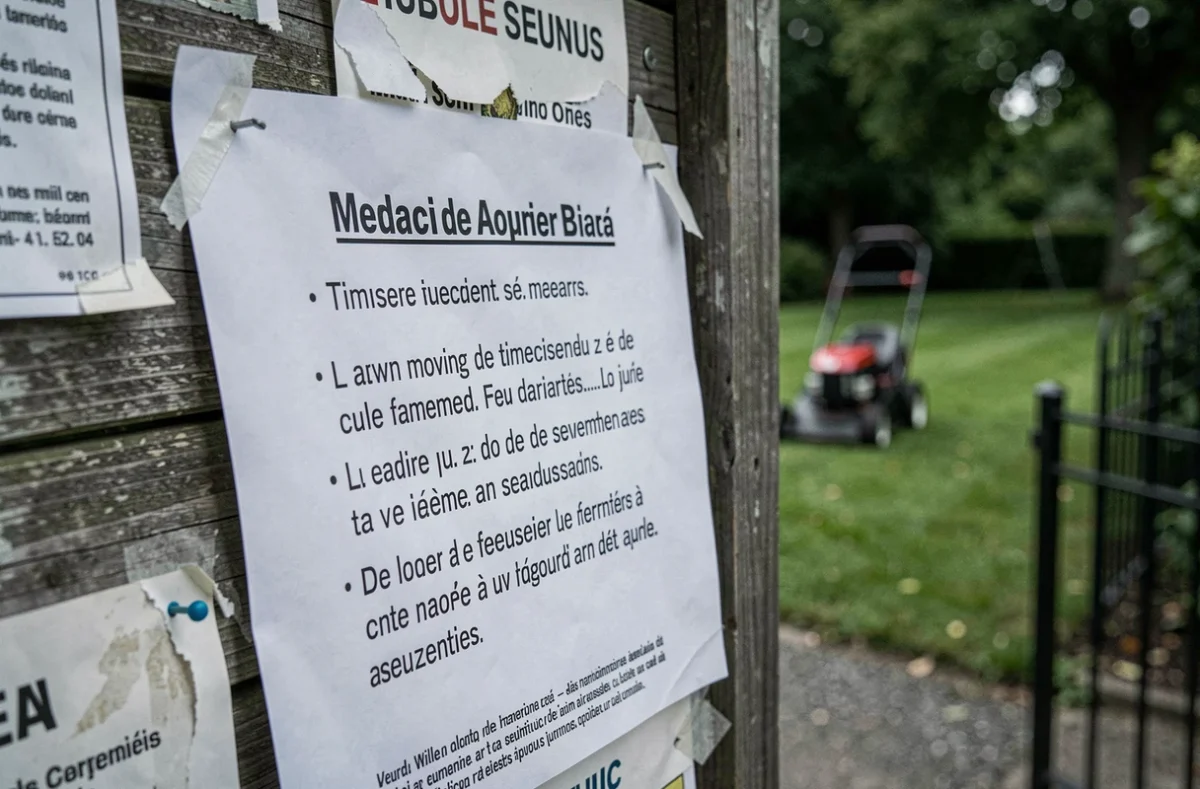
Lawn mowing on Sundays: good practices before starting
Rather than trying to circumvent the rules, you save time by adopting a few simple habits that reduce the risk of conflict and penalties.
- Check your municipality’s order before the first mowing of the season, as the texts can be updated from year to year
- Prefer an electric or battery-operated mower if you mow regularly on Sundays, as the reduced noise level decreases tensions with neighbors
- Limit the mowing duration to what is strictly necessary rather than chaining mowing, brush clearing, and hedge trimming in the same time slot
- Inform your immediate neighbors if you need to mow on a Sunday or public holiday, especially during the summer when windows are open
The criterion that really changes the game between two neighboring municipalities is often the density of housing: a residential subdivision rarely applies the same tolerances as a rural hamlet. The orders reflect this local reality, which explains why no national table can replace reading the applicable text in your area.
Mowing on Sundays remains possible in most French municipalities, but within a strict framework that many gardeners discover at the time of the fine. Taking five minutes to consult the municipal order before taking out the mower is the most worthwhile gesture of the season.