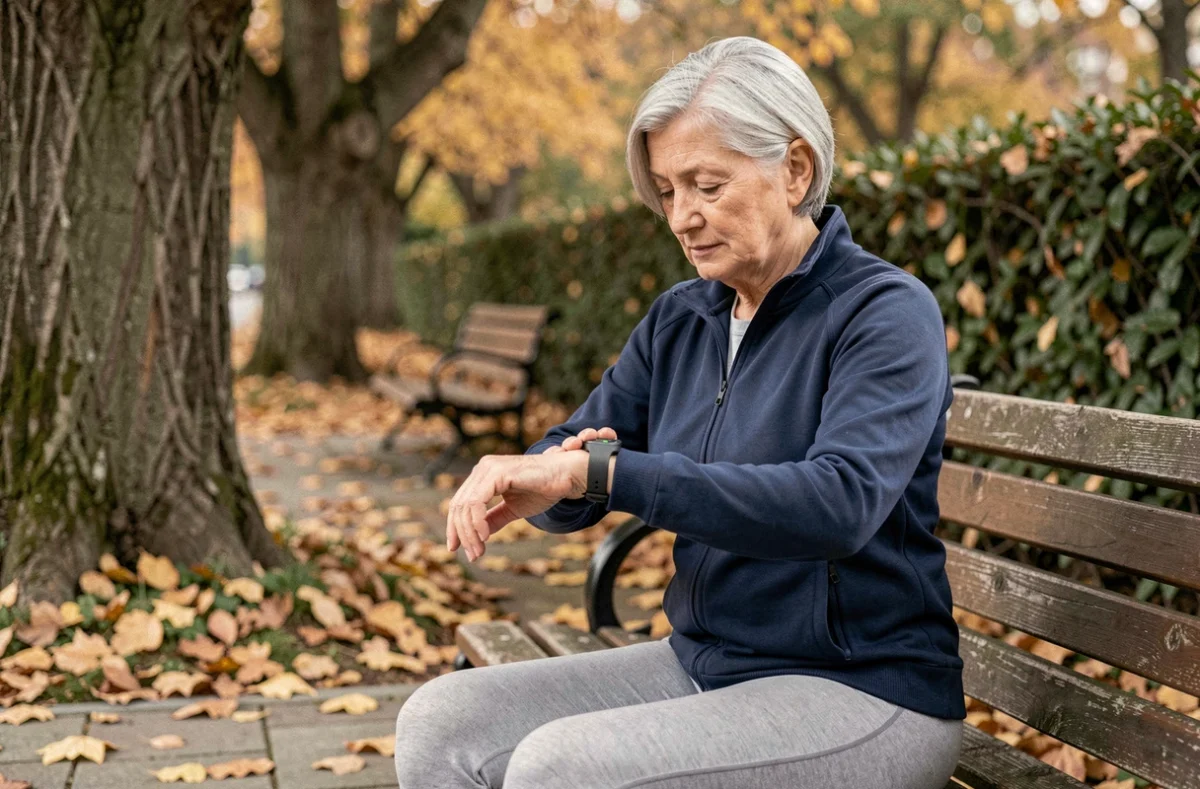
The commonly accepted range of 60 to 100 beats per minute at rest remains the reference for adults, including those over 70 years old. However, this benchmark masks significant clinical nuances: a pulse of 95 bpm at rest in a sedentary 70-year-old does not have the same meaning as a pulse of 58 bpm in a trained septuagenarian on beta-blockers. Resting heart rate is a marker of overall cardiovascular condition, not just a number to check off.
Pulse Regularity at 70: A Parameter as Decisive as Frequency
A heart rate within the normal beats per minute does not exclude a rhythm disorder. Atrial fibrillation, common in this age group, can present as an irregular pulse without the average frequency exceeding usual thresholds.
Specifically, a pulse of 72 bpm but with significantly varying intervals between beats from one cycle to another should raise concern. Recurrent palpitations, new fatigue, or shortness of breath with moderate exertion are associated signs. Atrial fibrillation must be confirmed by an ECG, not just by taking the pulse at the wrist or neck.
We recommend checking for regularity during each manual measurement: place two fingers on the radial artery for 30 seconds and note if the beats occur at equal intervals. A “skipping” or chaotic rhythm warrants a consultation, even if the final count remains within the normal range. To better understand what a normal heart rate at 70 years old corresponds to in your situation, pulse regularity is the first criterion to evaluate even before the number of bpm.

Beta-Blockers, Antiarrhythmics, and Heart Rate: Interactions to Know
Treatments profoundly alter resting pulse. Beta-blockers slow heart rate in a dose-dependent manner. A pulse of 52 bpm under bisoprolol does not have the same clinical value as a pulse of 52 bpm in a patient without treatment.
These molecules also diminish the compensatory increase in frequency when standing up. In an elderly person prone to dizziness upon standing, the pulse figure alone is not sufficient to explain the symptom: blood pressure and chronotropic response must be evaluated together.
Three situations require prompt medical advice:
- A pulse below 50 bpm accompanied by malaise, dizziness, or intense fatigue, especially if the treatment has recently been modified
- A resting frequency that suddenly increases by more than 15 bpm compared to the usual value, without exertion or fever
- Symptoms (shortness of breath, chest pain) occurring at a previously well-tolerated level of exertion
Never modify the dosage of a beta-blocker or antiarrhythmic without the prescriber’s advice, even if your pulse seems too low or too high.
Smartwatches and Atrial Fibrillation Alerts: Limits of Optical Screening
The 2024 European recommendations specify that a single-channel ECG of at least 30 seconds showing atrial fibrillation can contribute to diagnosis, provided a professional examines the recording. A notification based solely on a photoplethysmographic (PPG) sensor at the wrist does not constitute a diagnosis.
Optical sensors measure variations in blood volume under the skin. In elderly individuals, the reliability of the signal may decrease due to skin changes, reduced peripheral perfusion, or extraneous movements. An alert should be medically verified, but the absence of an alert does not guarantee the absence of a rhythm disorder.
The value of these devices lies in detecting intermittent episodes that the patient does not perceive. To derive real benefit, one must know what to communicate to the doctor: the ECG recording from the watch (if available), the exact time, and the symptoms experienced at the time of the alert.

Heart Rate During Exercise After 70: Adjusting Intensity Without the Magic Formula
The formula “220 minus age” gives a theoretical maximum heart rate of 150 bpm at 70 years old. This estimate underestimates or overestimates individual reality depending on training level, underlying conditions, and ongoing treatments. It should never serve as an absolute ceiling without prior exercise testing.
For regular and safe physical activity, an exercise test supervised by a cardiologist allows for determining the actual maximum heart rate and ventilatory thresholds. This data advantageously replaces any generic formula.
In the absence of an exercise test, the rate of perceived exertion scale (being able to talk without being out of breath corresponds to moderate intensity) remains a reliable reference. Shortness of breath preventing a brief conversation signals exceeding the moderate intensity threshold, regardless of the number displayed on the watch.
Warning Signs and Consultation Thresholds for the 70-Year-Old Patient
Resting heart rate must be interpreted in a global context. A stable pulse within the usual range, regular and asymptomatic does not require further investigation. However, certain signals necessitate a consultation:
- A newly irregular pulse, even without notable acceleration, which may indicate early atrial fibrillation
- A persistent resting tachycardia (above 100 bpm) without an obvious cause (fever, dehydration, anxiety)
- Syncope or pre-syncope associated with a slow pulse, especially in the context of polypharmacy
- Progressive shortness of breath with exertion and prolonged recovery compared to previous weeks
In case of chest pain, significant malaise, or loss of consciousness, call 15 or 112 without waiting to measure your pulse.
Heart rate after 70 should be monitored over time. It is the trend that matters, not an isolated measurement. Recording your resting pulse in the morning upon waking, two to three times a week, under the same conditions, constitutes the most useful follow-up to share with your primary care physician or cardiologist.